
Fast Track Programme: Course Guide 2025/26
Information about the Language Centre's Fast Track Modern Languages courses
Key Information
Our three-term Fast Track Programme is perfect for learners who are motivated and committed to progress faster. The Fast Track courses cover two learning Stages in one year. A more intensive and demanding pathway, Fast Track enables you to reach a higher level of competence in a given academic year (one stage higher than with the General pathway). This pathway covers all four language skills (speaking, listening, writing and reading), with the main focus being on communication. The courses also focus on language learning strategies and cross-cultural competences.
| Course duration | October to June (22 weeks in total) |
|---|---|
| When | Weeks 2-8 (Michaelmas term), Weeks 1-8 (Hilary term), Weeks 1-7 (Trinity term) |
| Class frequency | 1 class per week (online or in person) |
| Length of class | 2 hours |
| Online learning pathway and private study | Up to 4 hours per week |
| Total | This represents a guided learning programme equivalent to around 4 hours of asynchronous learning plus 2 hours of live interaction each week. |
| Enrolment basis | First come, first served |
Fast Track courses follow the progression of the Common European Framework of Reference for Languages (CEFR). Elective assessments at the end of the course lead to a certificate of completion awarded by the Language Centre. Where there is an established scheme with your faculty or department, the course assessments may also contribute to your degree course (see the information for sponsored students). If you are going to be at Oxford University for three years and enrol on our Fast Track pathway to learn a new language, you can reach level B2 or level B1 for non-European languages by the time you graduate. Please note that your CEFR level outcome may vary depending on the language that you are learning and on your own progress. Our certificates of course completion include a CEFR indicator based on your progression during the academic year and on your performance at the end of the course.
Courses on the Fast Track programme are available in the most popular languages taught at the Language Centre from Stage 1+2 (beginners) to Stage 5+6.
| Stage 1+2/A1 | Stage 2+3/A2 | Stage 3+4 | Stage 4+5 | Stage 5+6 |
Missing stages? |
|
|---|---|---|---|---|---|---|
| Arabic | ✓ | ✓ | Please see our General courses |
|||
| French | ✓ | ✓ | ✓ | ✓ | ✓ | |
| German | ✓ | ✓ | ✓ | |||
| Italian | ✓ | |||||
| Japanese | ✓ | ✓ | ||||
| Mandarin | ✓ | ✓ | ||||
| Russian | ✓ | ✓ | ||||
| Spanish | ✓ | ✓ | ✓ | ✓ | ✓ | |
Our approach to teaching languages is action oriented, needs based and using meaningful and authentic documents as much as possible to support you in developing the necessary skills to achieve a higher level of competence in line with CEFR benchmarks.
Our approach aims to be informed by research and scholarship in the fields of Applied Linguistics, Second Language Acquisition and Educational Technology. We work closely with the learning framework developed by the Association of University language Communities in the UK and Ireland (AULC) and with the Flexible and Inclusive Teaching (FIT) framework of the University of Oxford's Centre for Teaching and Learning. We aim to be inclusive, helping learners from a wide variety of backgrounds develop or maintain their foreign language skills, employing the most up-to-date practices grounded in cutting-edge scholarship.
We teach our courses through a flexible and inclusive mode of delivery.
Each week of your Fast Track course you will:
- Complete an online learning pathway focusing on language instruction, exercises and drills, and communicative collaborative activities using Canvas (the University's Virtual Learning Environment). Each learning pathway aims to prepare you and support you to fully engage in the classroom activities.
- Attend a 2 hour weekly class mostly focusing on conversation in groups of normally up to ten students (online) or 16 students (in-person). Conversation sessions are scheduled at various times of the day, including early evening, and take place either online via MS Teams or in person at the Language Centre.
This mode of delivery enables you to:
- Work flexibly at your own pace.
- Have access to a complete set of learning materials before each class and beyond the life of the course to master and review (you will retain access to the materials in Canvas at least until the start of the following course).
- Get high quality generic and individual feedback
- Use class time to interact with your peers and tutor, which gives you an excellent opportunity to put your weekly learning into practice. If you enrol on an online course, the conversation classes on MS Teams are recorded to enhance learning and support efficient feedback from your tutor. The recording will only be available to students registered for the class. External learners need a Microsoft account to access online recordings on Canvas.
The 22 weeks of delivery are structured to support your learning and the development of personalised learning strategies. In addition to the 18 learning pathways, time for revision, tasks, reflection, feedback, and preparation is factored in:
| Weeks of term | What is covered |
|---|---|
| Michaelmas term Weeks 2-7 | 6 learning pathways |
| Michaelmas term Week 8 | Revision, tasks, reflection, and feedback |
| Hilary term Weeks 1-6 | 6 learning pathways |
| Hilary term Week 7 | Progress test (all classes take place online) |
| Hilary term Week 8 |
Feedback on the test, reflection and preparation for end of course assessments |
| Trinity term Week 7 |
Classes: viva and discussions |
This is a demanding course (a rewarding one, too!) for those who are strongly motivated to learn, and it is important to ensure that you join the right Stage. The Fast Track Programme has 6 double Stages (e.g. 1+2) which are calibrated on the Common European Framework of Reference for Languages (CEFR).
If you already have some prior knowledge of the language you wish to study, you will need to take a language level evaluation test when you enrol to check which Stage matches your current learning needs by visiting our dedicated 'assess your level' webpage below:
If you have no prior knowledge of the language, you may enrol directly onto Fast Track 1+2 (French, German, Italian, Portuguese or Spanish) or Fast Track A1 (Arabic, Japanese, Mandarin or Russian).
If you are continuing from a previous Fast Track course, you will normally need to join the next Stage up (for example, if you took Fast Track 1+2 you will need to progress to Fast Track 3+4 (or Fast Track A2 if you completed Fast Track A1).
Once the course has started your tutor will be ensuring that all learners are studying for the Stage that most suits their needs.
We have designed all our courses to enable learners to progress as far as possible. However, the highest level we offer in a language is conditional on sufficient levels of demand.
To progress from one Stage to the next, you do not need to have completed or passed the optional assessments, but we highly recommend that you take our language level evaluation test to receive adequate advice on the best next course available to you, as you may have progressed during the long vacation. Fast Track is a more intensive programme than our General or Academic pathways, to facilitate a faster acquisition of language skills in the elementary and intermediate levels of competence. Beyond a level B2, the threshold to C1 becomes slower and more reliant on periods of study or work abroad and a frequent level of exposure to the language. Progression beyond Fast Track 5+6 is through our General Stage 7 courses. Every learner is different, so your tutor will be best placed to advise you on the best progression route for you.
Progression from a Fast Track course to General pathway
Our pathways are designed to give you maximum flexibility in terms of changing the course and intensity of your learning journey. If you wish to progress from a Fast Track course to a General course, you simply move up to the next stage. For example, if you have finished Fast Track 1+2, you can progress to General Stage 3 Part 1.
At the end of the academic year or at the start of the enrolment period, contact your tutor and seek further advice on the options they would recommend for you.
In line with the Association of University Language Communities (AULC) our learning framework recognises the different pace of progression to CEFR B2 depending on the language.
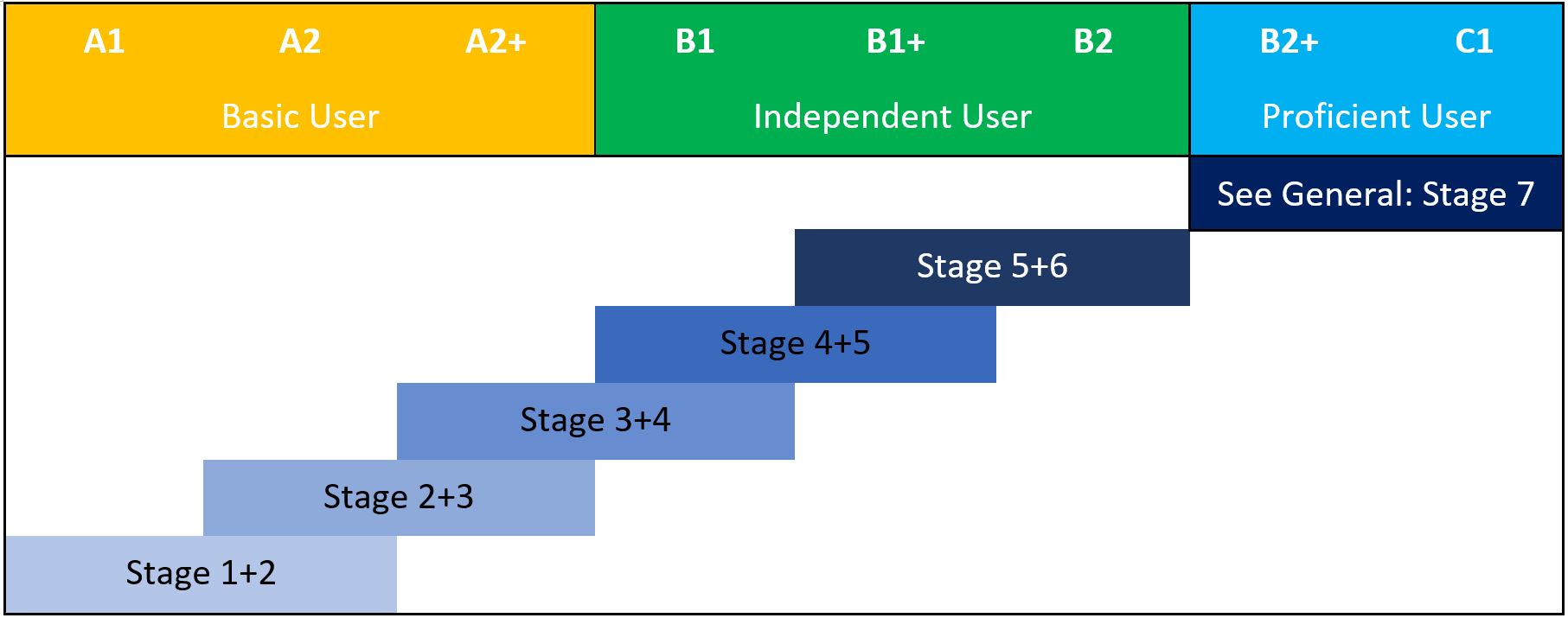
For French, German, Italian, Portuguese, and Spanish we expect learners to be able to reach level B2 in three years of study on this pathway (Fast Track 1+2 followed by 3+4 and then 5+6). In some languages we also offer courses starting from some basic prior knowledge (progression from Fast Track 2 +3 to 4+5 and then possibly to a General Stage 6 course to reach level B2).
learning framework fast trackMihaly Orsovszki July 2025
Our Fast Track courses in Arabic, Japanese, Mandarin Chinese and Russian are named A1, A2, B1 and B2 rather than by Stage combination and they offer a progression to level B2 over four years of study.
For members of Oxford University with a Single Sign-On, to enrol simply visit our language pages and click 'enrol' next to the class that you wish to join on the timetable. Before you click through to complete your booking and pay, do double-check that you have selected the course running on the day and time that suit you. Also note that the default price until you reach the payment page is set at the staff rate – the system will auto-correct the price to the student fee based on your SSO status before you are asked to input your credit or debit card details.
If you do not have a University Single Sign On (SSO), please email admin@lang.ox.ac.uk with the following details:
- Full name
- Email address and phone number
- The name of the course you wish to study (including Stage and Part)
- The start date and time of the course
- Your connection to Oxford University, if any (to determine course fee)
We will then provisionally enrol you onto the course and send you a link to the Oxford University Online Store for payment. Once payment is received, we will confirm your place on the course.
Please note that in accordance with the Terms and Conditions, you have the right to cancel your course booking at any time within 14 days of payment. Unless
the course has started, you will receive a full refund of any payments you have made and no administration fee will be charged. For cancellations after 14 days, and for cancellations made after the course has started, please see our Terms and Conditions. If you have an Oxford SSO you can cancel your place via your CoSY account. If you don't have an SSO, please email admin@lang.ox.ac.uk with your cancellation request.
Course Fees
Fast Track Fee Reimbursement
All Language Centre courses make extensive use of Canvas. All our courses are developed on an inclusive and flexible blended learning model, which rests upon multimedia pathways designed by our tutors for you in Canvas.
In addition to this, we may ask you to purchase a textbook. The list of textbooks will be confirmed before week 0 in Michaelmas term. As far as possible we endeavour to ensure that textbooks are economical and readily available, by liaising with specialist bookshops and publishers.
Blackwell's offers a 15% student discount at the beginning of each term for orders placed by phone or in the shop in Oxford (this does not apply to online orders). Please note that the Blackwell's buy-back scheme is no longer available.
We also host a second-hand textbook forum on the Virtual Language Centre in Canvas to help our community of learners sell and acquire textbooks. To check the availability of a given textbook or to sell one, please register on our Virtual Language Centre site on Canvas and follow the link to second-hand books.
A learning pathway is a unit of learning leading to a live language conversation class. Learning pathways typically include the sort of activities and tasks that are normally covered in a traditional face-to-face language class – or as part of the preparation towards that class – and which learners can do independently or collaboratively without necessarily being together at a given point in time.
For example, in a face-to-face class, the teacher usually explains new linguistic structures: grammar instruction is a good example of classroom learning that a tutor can prepare and include in a learning pathway. Below is an example that follows very closely what would have happened in the classroom:
- Using a screencast video the tutor explains the use of different structures to express needs and preferences in Spanish and then learners can do a variety of exercises to apply / practise this new knowledge.
- You may play the recording as many times as you wish and if you are unsure about anything we include numerous opportunities for learners to sort out questions between themselves or to ask their tutor.
- In the learning pathway, learners may have to reflect about language use themselves first – through a quiz, for example – and the tutor may then provide the explanation based on the learners' responses
- In addition to language instruction and practice quizzes, the learning pathways include reading, listening, and communicative tasks using discussion tools (text or voice or video)
You can request a certificate of attendance if you have attended/engaged with at least 80% of the course.
Fast Track courses have three assessments, leading to a certificate of course completion. These are not compulsory but may be required for a college partial reimbursement: you should check what your college requires.
You can obtain a certificate of course completion if:
- You have attended/engaged with 80% of the course
AND
- You have taken the 3 assessment components
The certificate is usually required for a college partial reimbursement. You should check what your college requires.
Certificates of course completion will normally be emailed to students by the end of Week 9 in Trinity term.
You may request a certificate of course attendance: as the assessments on our Fast Track courses are optional, if you have attended/engaged with 80% of the course but not completed the assessment components, you may request a certificate of course attendance by emailing admin@lang.ox.ac.uk.
The Fast Track assessments include:
Progress Test (Hilary term Week 7)
Comprises: listening comprehension, reading comprehension, use of language, writing task, and speaking task. It will take place online through Canvas and will last 2 hours, therefore all classes in week 7 of Hilary Term take place online.
Reflective Portfolio (Various dates during the course)
Comprises: 2 reflective entries on your work during the course.
Research project: video presentation and viva (Trinity term Week 7)
Comprises: reading, research, spoken production, spoken interaction, and listening skills. Learners record their presentation as a video and share it with their tutor and classmates via Canvas. Class time is then dedicated to questions or discussions related to the presentation.
If you wish to make progress in the language you are studying, regular engagement with the tasks and activities and participation in the weekly classes are both very important. We understand that it may not always be possible for our learners to attend their classes every week. If you know you will be absent, please inform your tutor but make sure that you are continuing to engage with your learning pathway activities.
If you are absent from a class, it is your responsibility to catch up on the work you have missed. All materials (including a recording of the live session if you are enrolled on an online course) are available on Canvas, as well as the tasks set by the tutors to prepare for the next session. If you are struggling to catch up after having missed a session, you may post a question on Canvas to seek help from our community of learners, or you may raise this with your tutor by emailing them via Canvas.
Remember that in languages regular practice is important – if you miss a class, particularly on a lower-level course, you may have missed a lot of important new structures and explanations. Not keeping up with the pace of the course may also be disruptive to the quality of the course. It is your responsibility to remain engaged and seek support in a timely manner if needed.
If you are experiencing difficulties managing your engagement or coping with the demands of the course, do make sure to discuss this with your tutor. The Fast Track programme is demanding, but it also has important moments for reflection and revision.
All our courses are subject to quality monitoring and annual review cycles.
We collect feedback from our learners informally during the course and formally at the end of each term. We review your feedback and where possible adjust our courses and systems in light of your experience at the Language Centre.
Below are just a few examples of comments made by our learners:
'I enjoy the conversation between students. Meanwhile, the learning curve of the course is steep, and the challenge gives me more motivation to finish the course.'
'Feeling like I am making progress and understanding more and more of my target language. The teacher is very friendly, and the classmates are supportive.'
'I loved the online learning pathway as I knew beforehand what that week's lesson would be on. It allowed me to prepare and read in advance (I am a slow reader) and use the class time to engage in speaking practice and ask any question in a discussion forum.'
'The teacher was amazing! Engaging, fun and precise, always accommodating requests but never losing the goal and pace. I am really grateful!'
'I found the conversation classes online very useful. The tutors were wonderful and having the small group setting was so useful. I liked that the tutors would provide pronunciation/ grammar tips at the end of a session.'
'I really liked the pre-recorded lectures, being able to re-watch sections on grammar points is very useful. I wouldn't mind if future courses remained in-part online.'
'I found the online format to be much more convenient. I could fit in my class around my usual working day. I think it made learning easier.'
'This has been an amazing course, I've always struggled to feel I was progressing with this language and constantly ended up back in beginners' classes. Having spoken to my tutor beforehand, I felt the class was the right level for me. I have learnt so much this year, I have never felt so satisfied with a language course before. I'm very much looking forward to continuing next year; these classes are definitely the best I have come across.'
If you are dissatisfied with any aspect of your learning, your first port of call should be to raise the matter directly with your tutor. Where you feel that this is not possible, you should follow our complaints policy.
For online or any hybrid delivery courses, there may be a weekly online conversation class delivered through MS Teams or Zoom: this session may be recorded and saved to enhance learning, allow catch up/revision and support efficient feedback from your tutor. The recording will only be available to learners registered for the course, your tutor and any supporting administrators. Recordings are kept for up to one year then deleted.
Recording retention policy: information for learners
Language Centre online conversation classes may be recorded and saved to enhance learning, allow catch up/revision and support efficient feedback from your tutor. As the organiser of these meetings, the Language Centre and its tutors follow the University's best practice guidelines, as below:
- Consideration is given to the classification and sensitivity of any material being discussed.
- Learners are advised that recording is taking place, with MS Teams/Zoom automatically displaying a message informing all those in the teaching session that the class is being recorded. Learners are also advised in advance through the course guide and our terms and conditions.
- The tutor is responsible for the onward sharing to participants, dissemination, retention and deletion of recorded teaching sessions, which are stored within the Canvas VLE. Recordings are kept for a maximum of one year and are then deleted.
- The tutor ensures that the recording complies with the University's Regulations for the Administration of Intellectual Property.
Class participants
- Any participants who have concerns about being recorded are asked to discuss these with their tutor in advance.
- Participants should ensure they have muted their microphone if they do not wish to be recorded.
- Participants may not use third-party video or screen capture services (or a separate recorder) to record the meeting unbeknown to the organiser or other attendees. Any participant who records a session without explicit authorisation to do so will be in breach of University policy and subsequently the IT regulations.
If a participant has a concern or query regarding matters relating to recorded personal information, this should be referred in the first instance to the Language Centre's Admin team: admin@lang.ox.ac.uk.